What Is Arbitrage and Types of Arbitrages
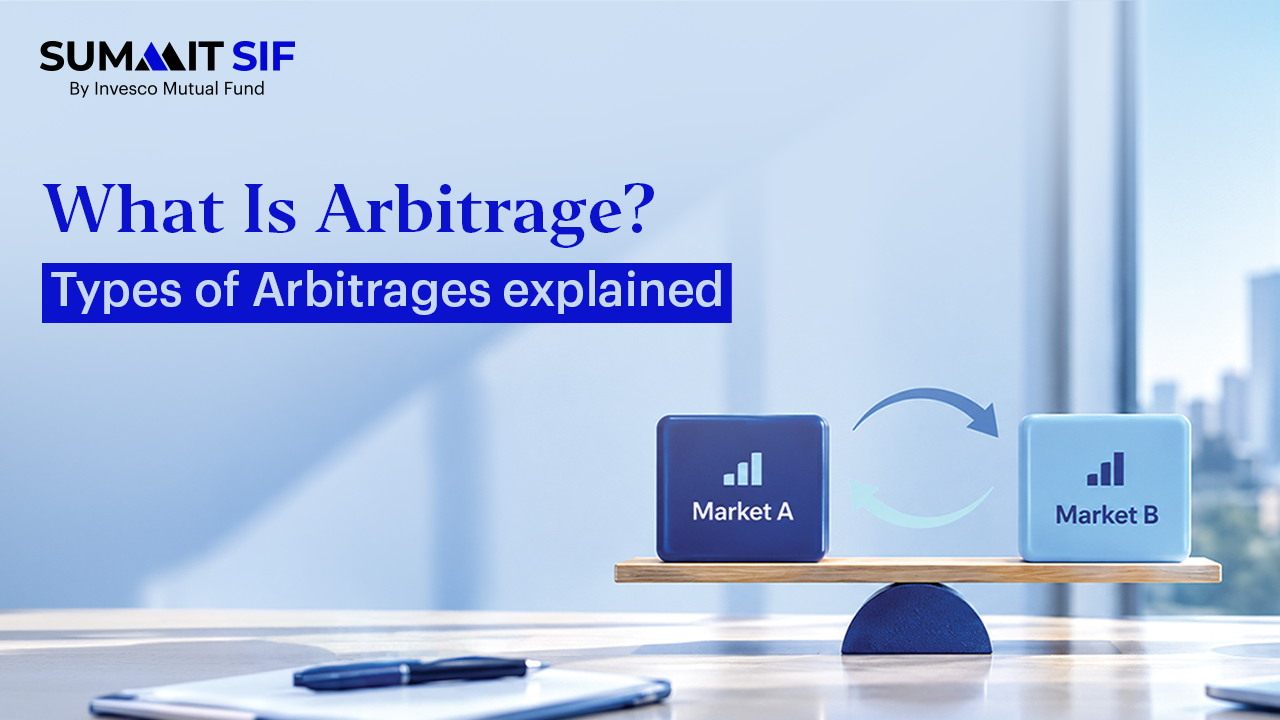
Picture a Sunday farmer's market. At one stall, mangoes sell for ₹80 a kilo. Walk fifty metres to the next row, and the same variety, same size, same ripeness, goes for ₹110. A sharp-eyed shopper buys a sack from the first stall and, if she could, would sell it immediately to the second stall's customers for ₹110, pocketing the difference before either seller notices the gap.
That, in essence, is arbitrage: profiting from a price difference for the same asset in two places at the same time, with low risk, because you're buying and selling simultaneously rather than relying on where the price goes next.
Meaning and definition of Arbitrage
In financial markets, arbitrage means simultaneously buying an asset where it's cheap and selling it where it's expensive, locking in a profit that exists purely because of a temporary mispricing, not because you predicted the future. It's less "investing" and more "spotting the market talking to itself in two different voices at once."
These gaps rarely last. Algorithms or high-frequency traders close them in seconds or milliseconds. The principle of arbitrage has evolved into several sophisticated strategies that professional traders and fund managers still use every day. Let's walk through them.
1. Synthetic Arbitrage
Synthetic futures involves building a position for an asset using other instruments to replicate the same payoff as that of the asset's futures using combinations of options, futures, and the underlying stock, a trader can construct a "synthetic" position that should, in theory, be priced identically to a real one (this pricing relationship is called put-call parity in options markets). When the synthetic version and the real version drift apart in price, traders buy the cheaper one and sell the pricier one, capturing the spread as the two converge back to fair value.
2. Commodity Arbitrage
Commodities like oil, wheat, gold, copper, trade on exchanges across the globe, and the same physical good can carry different prices depending on location, storage costs, currency, and delivery timing. Commodity arbitrage exploits these gaps: buying crude oil in one market and simultaneously selling a futures contract in another or exploiting the price difference between a commodity's spot price and its futures price. Because commodities involve physical delivery, storage, and shipping, this form of arbitrage often demands deeper logistical know-how than purely financial trades.
3. Merger Arbitrage
Also called "risk arbitrage," this strategy plays out around corporate mergers and acquisitions. When Company A announces it will acquire Company B resulting in a mutually agreed merger ratio between the two stock prices. But this ratio usually does not stay static during the merger process. Why? Because there's still a chance the deal falls apart, faces regulatory hurdles, or takes longer than expected. Merger arbitrage traders take opposite positions in the acquiring and target companies and seek to benefit from the gap closing once the deal officially completes. It is driven by deal certainty rather than market direction, which is what makes it a form of arbitrage rather than pure speculation.
4. Index Arbitrage
Index Arbitrage seeks to capture pricing differences between an index's constituent stocks and its corresponding futures. The strategy involves buying the underlying stocks in the cash market and simultaneously selling index futures, with returns driven by the spread between the two markets. Managers may further enhance returns by selectively utilizing stock futures where available, while maintaining an arbitrage-based approach. These opportunities are typically found in liquid indices such as the Nifty 50 and Nifty Bank.
Why This Matters
Arbitrage strategies involve seeking to benefit from temporary pricing differences between related securities or markets. The execution of such strategies may contribute to the convergence of prices over time. Understanding various arbitrage approaches may help enhance awareness of how different market segments interact and how pricing differences can arise and adjust.
Disclaimer: The above arbitrage strategies are solely for investor education purposes. Actual deployment of such strategies, if any, shall depend on market conditions, availability of opportunities and regulatory provisions. Arbitrage strategies are subject to market, basis, liquidity and execution risks and do not assure any return or performance. For offsetting of positions, futures and options contracts shall be on the same underlying security and have the same expiry date otherwise such positions are not treated as fully hedged positions and counted as two separate positions for the purpose of calculating exposures. While strategies seek to mitigate market risks and capture arbitrage opportunities, they may not eliminate all the risks and should not be construed as capital protection, guaranteed returns, or a risk-free investment.
Frequently Asked Questions
1. What is an arbitrage?
Buying an asset in one market at a lower price and simultaneously selling it in another market at a higher price can be called as an Arbitrage.
2. Is arbitrage completely risk-free?
No. Arbitrage is not risk-free. While the concept of arbitrage aims to capture price differences with minimal market risk, real-world arbitrage strategies can be exposed to basis risk, execution risk, timing risk, liquidity risk, operational risk, etc., and, in certain cases such as merger arbitrage, deal-completion risk. As a result, arbitrage is generally considered a low-risk strategy, not a risk-free one.
3. Why does merger arbitrage exist if the deal price is already announced?
Because deals can be delayed, renegotiated, or blocked by regulators. The gap between the current stock price and the announced deal price reflects that uncertainty, which is exactly what merger arbitrageurs are pricing and trading.
An investor education and awareness initiative.
For Know Your Customer (KYC) guidelines along with the documentary requirements and procedure for change of address, phone number, bank details, etc., please visit the Education and Guidance section on https://summitsif.invescomutualfund.com/educate-yourself. Investor should deal with only SEBI registered Mutual Funds, details of which can be verified under "Intermediaries/Market Infrastructure Institutions" on https://www.sebi.gov.in/index.html. For any grievance / complaint, please call us on 1800-209-0007 or write to us at care@summitsif.com. Alternatively, complaints can be registered on the SEBI SCORES Portal at https://scores.sebi.gov.in. Investments in Specialized Investment Fund involves relatively higher risk including potential loss of capital, liquidity risk and market volatility. Please read all investment strategy related documents carefully before making the investment decision.